


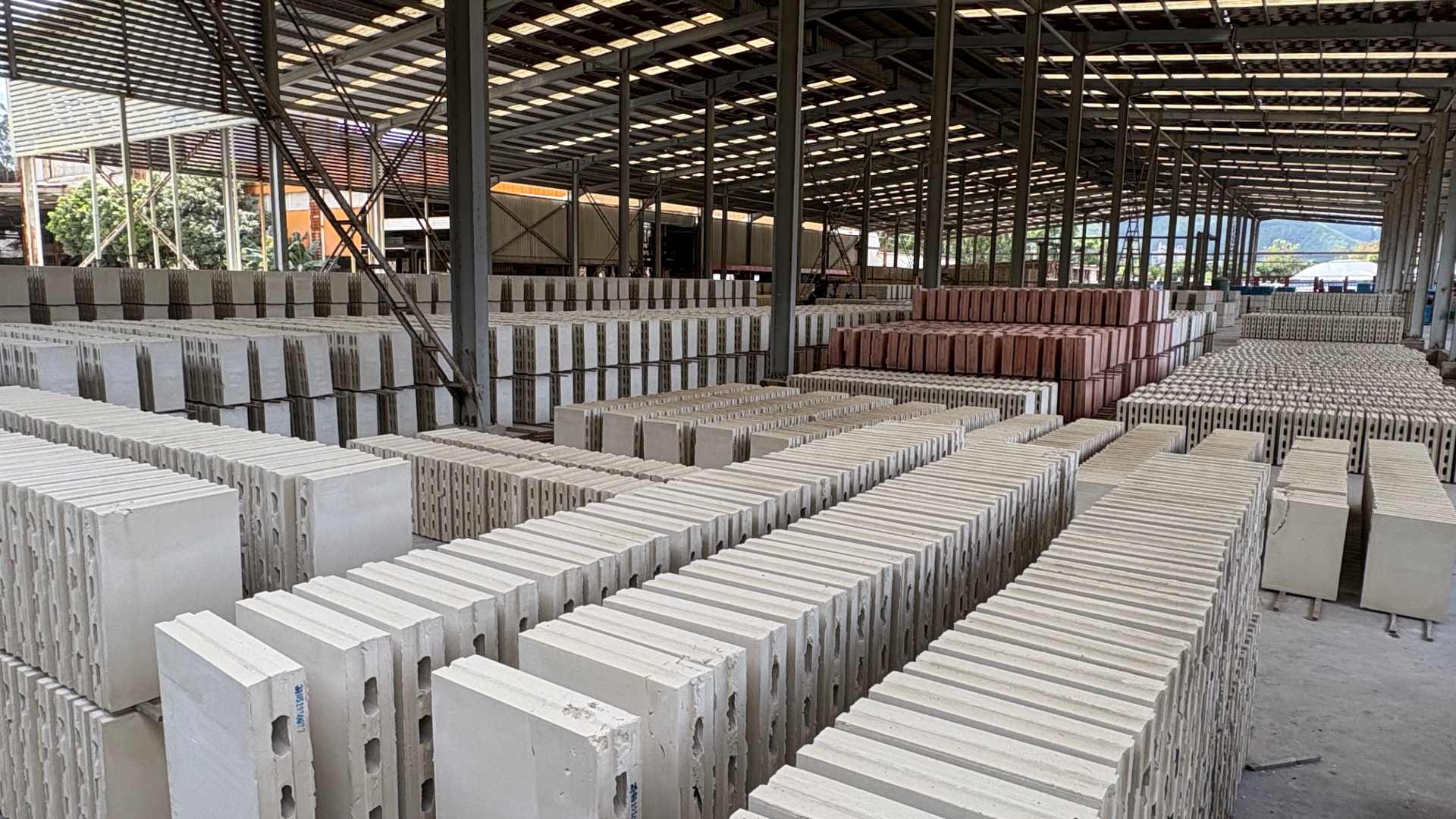
Aerated blocks, gypsum boards, and gypsum blocks are all wall building materials with their own uses and advantages. What are the differences among them as building materials?
gypsum block
Gypsum blocks are currently being used in the construction market and have the following characteristics:
Excellent fire resistance performance:
The main component of gypsum blocks (CaSO4 · 2H2O) contains two crystal waters, accounting for approximately 21% of the proportion. Crystalline water exists stably in gypsum during normal times. When exposed to high temperatures, this water can quickly diffuse into the air on the surface of lightweight materials, forming a layer of "water vapor carbon" on the surface of lightweight materials. This can not only reduce the surface temperature of the wall material, but also serve to isolate oxygen, thereby preventing and delaying further combustion of the wall material and building. A gypsum block wall with a thickness of 100mm needs to evaporate about 20kg of water per square meter during a fire in order for the wall to further heat up. The temperature can only continue to rise when it reaches the decomposition temperature of 1400 ℃.
The compressive strength of aerated concrete blocks will decrease in environments above 600 ℃.
The "Classification Method for Combustion Performance of Building Materials" and "Test Method for Difficult Combustion Performance of Building Materials" promulgated in China in 1998 have classified gypsum products as non combustible. Belongs to Class A non combustible materials
Excellent insulation, heat insulation, and sound insulation performance:
The excellent sound insulation performance of gypsum blocks not only depends on the material itself, but also on the construction process of dense grooves with few gaps. The bonding between blocks uses high-strength adhesive with fine aggregates, and the gap between blocks is not greater than 3mm, which can ensure the sound insulation effect of the entire wall.
The thermal conductivity of gypsum blocks is 0.11-0.14W/m · k. Generally, a 150mm thick gypsum hollow block wall has the same insulation capacity as a 200mm thick solid brick wall.
High stability and resistance to cracking:
The hydration products of cement and various silicate based materials are mainly colloids, which are prone to expansion and contraction when the external temperature changes. The hydration period is usually relatively long (up to several decades), and some deformation will occur during the hydration period.
The hydration products of gypsum based materials are crystals, and the hydration period is usually very short. There is deformation during the hydration period, but after the hydration crystals form a network, they are basically not affected by changes in external temperature, so the block itself is basically not deformed. Its expansion and contraction rate is 1/20 of that of cement and silicate products under equal conditions.
In addition, the adhesive used for masonry blocks is also formulated with gypsum, and their expansion and contraction rates are consistent. Under the interlocking effect of concave and convex grooves, it can perfectly form a whole wall without cracking easily.
Good seismic performance:
On the premise of meeting the functional requirements of the building, Lida gypsum blocks are much lighter in weight than aerated concrete blocks, belonging to lightweight partition walls, with good seismic performance, and can reduce the construction cost of the main structure.
Comfortable breathing function:
Gypsum blocks have a breathing function, which means they can regulate indoor air humidity. The microporous structure of gypsum is composed of intersecting needle shaped crystals of dihydrate gypsum, so there is a large amount of free space in the needle shaped crystal structure.
When the humidity in the air conditioning system is high, gypsum can absorb moisture from the air through its capillary structure, with a water storage rate of 7-17g/㎡, which is nearly twice as much as cement mortar (with a water storage rate of 6-9g/㎡).
Because the water vapor diffusion resistance coefficient of gypsum is much lower than that of cement mortar, when the air humidity decreases, the moisture in the gypsum capillary structure is easily evaporated into the air without affecting the firmness of the wall.
So, gypsum blocks have the function of regulating atmospheric humidity and can adjust indoor microclimate. The wall also has no condensation water when the air humidity is high, making people feel comfortable.
Aeration block
Aerated block, also known as "autoclaved aerated concrete block", is an aerated concrete block produced through high-temperature autoclaving equipment technology.
Characteristics and advantages of aerated blocks:
The aerated block has a light bulk density, insulation, heat insulation, and sound insulation, is easy to process, and is made of various mixtures, with abundant production materials. Especially when using fly ash, it can comprehensively utilize industrial waste, control environmental pollution, and save arable land, which has good social and economic benefits. It is a wall material that can replace traditional solid clay bricks.
gypsum board
Gypsum board is mainly made of gypsum, with fibers, adhesives, and modifiers added, mixed, pressed, and dried. This type of gypsum board is mainly used for ceilings, partition walls, interior walls, and veneer panels.
Gypsum board takes building gypsum as the main raw material, which can be mixed with light aggregate, made hollow or introduced with foam to reduce self weight and thermal conductivity; Fiber materials can also be added to improve tensile strength and reduce brittleness; Silicon containing mineral powder or organic waterproofing agents can also be added to improve its water resistance.
The characteristics of gypsum board are lightweight, heat-insulating, non combustible, sawable and nailable, sound-absorbing, moisture regulating, and beautiful. But it has poor moisture resistance. Gypsum board is mainly used for interior wall and ceiling decoration, isolation walls, insulation materials, sound-absorbing materials, wood substitute materials, etc.
Reprinted: China Construction Research Institute Gypsum Industry Branch